**There are a few more posts, that are unfinished, that will be added under the “Bangkla Nights” category**
The extraordinary...
Tuesday, August 3, 2010
Final Thoughts
**There are a few more posts, that are unfinished, that will be added under the “Bangkla Nights” category**
Saturday, July 31, 2010
Bangkok: Royal Palace, Souvenirs, and Master of the Piki Nu
Bangkla: Tying Up Lose Ends, Surprise for Maw Willis, and Korean Fondue
I tend to remember last days, my last day of high school, my last day of college, my last day of any given job. There is something about the near sight of change that plucks a sentimental string and encourages me to make the most of what is left. While my life is no “Carpe Diem” scene played out from The Dead Poet Society, occasionally, I get it right an appreciate what is around me. Thursday is my last day in Bangkla.
I wake up to the same familiar routine that now seems like home and make a list of all of the things I would like to do before I leave Bangkla: take pictures for Aunt Kaye, scan old photographs of the hospital, visit the Baptist Church, spend time writing at Ran Jeck Cheu’s, spend nit noi more time at the hospital watching Granddaddy. I accomplish all of the things on my list and end the workday with my grandfather at the hospital. I sit and observe as he sees his last patient and walk with him back to the apartment for rest some before dinner.
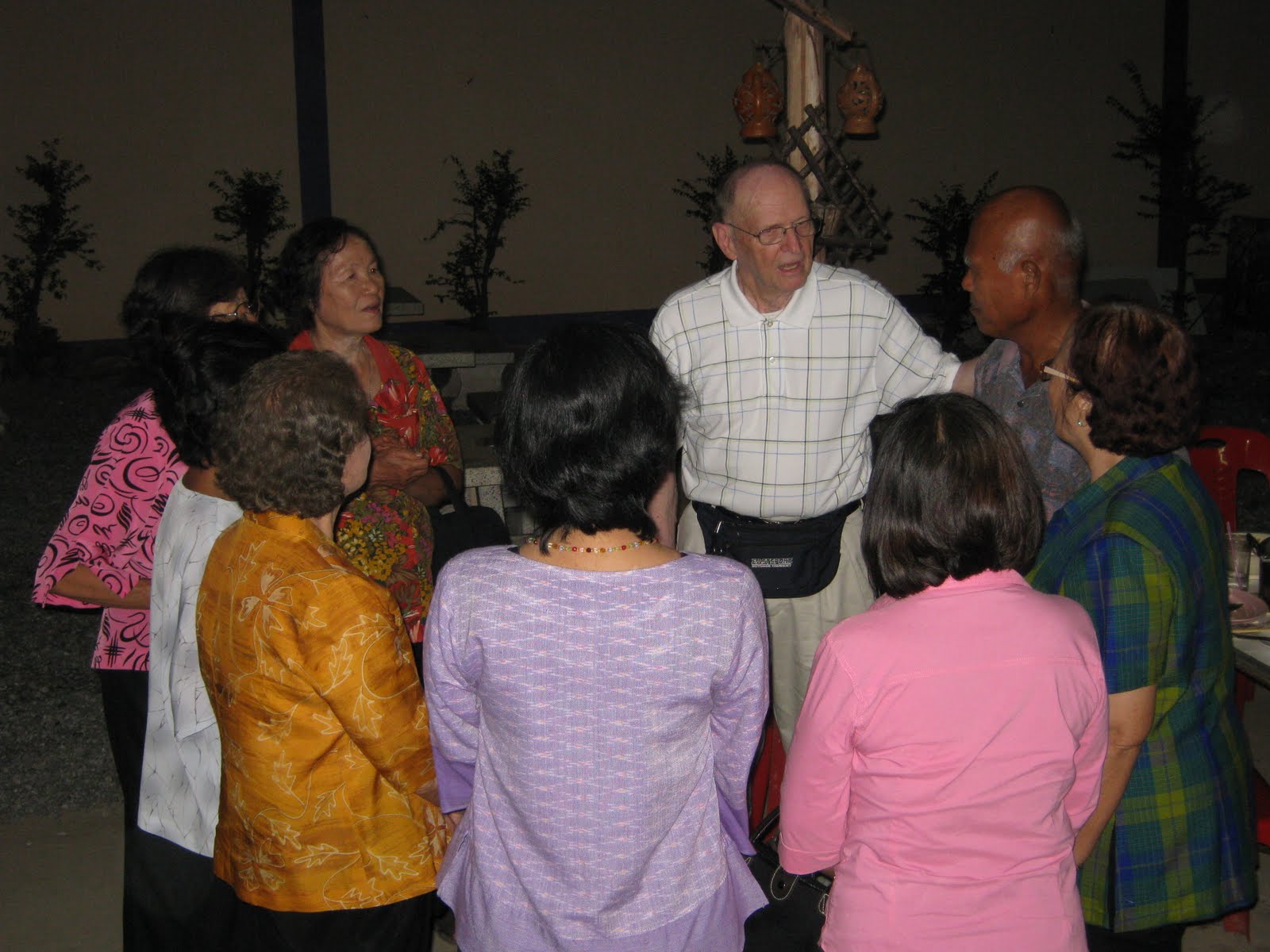
All my grandfather knows about dinner is that Gai and Et have asked us if they can take us out. Gai shares with John Mark and I that she is planning a surprise for Maw Willis. They pick us up at 6:00pm and take us to an open-air restaurant similar to most of the other restaurants we have eaten at. Waiting outside the restaurant is a small group of people. I see the same look on my grandfather’s face that I saw when we first came into view of the hospital, two weeks before. The surprise Gai has planned was calling three or four of the original hospital staff, all senior citizens now, and having them meet us for dinner. What we did not anticipate was those people would call more people. I watch the group of nine as they crowd around my grandfather, who is thrilled beyond measure at his surprise.
We walk into the Korean fondue restaurant and sit down at four tables that have been placed together. Soon our waiter walks to our table with a large stone pot that has burning wood inside. He places the pot on the table, then places a pan on the pot, a guard on the pan and puts a soup in the pan. The pan has a raised dome in the center. Soon bowls filled with different assortments of meat are delivered to our table. A piece of pork fat is place in the top center of the dome and the meat is put around the rest of the dome to cook. Cabbage, noodles, and carrots are placed in the soup to cook. The meal is one of the most interesting I have ever had. The food tastes good and there is plenty to pass around. As the hospital veterans look at old photos, Et commandeers my camera and spends time photographing the group. Towards the end of the meal Agan Neetat arrives to say hello to everyone. He tells me that the tailor has already finished my coat and gives me a bag with my present inside. We laugh, smile for pictures, and stay later then we intend, but it is worth ti to see how much fun my grandfather has. He comments, “This is the perfect cap to a great two weeks.”
Nahonnyak/Prachinburi/Khawhinson: Waterfalls, Dams, The Tailor, and Church
**I will edit and add picture when I have some more time**
I once read a short book that explained the evolution of going over Niagara Falls in a barrel. While in the beginning a beer keg type barrel was employed, through time and technological advancements the barrel turned into a modernized metal role cage in the shape of a barrel. My question is, “Who was the first person to look at Niagara Falls and say, ‘Yup…I need to go over that…in a barrel.’” One of the most awe striking waterfalls in the world, thousands of tourists flock to it’s viewing decks and ferryboats each week. I have never seen it in person but I have seen the Nahonnyak, Thailand equivalent.
Wednesday morning I wake up to my normal routine. After our morning skype calls, I find a box of old photographs and begin looking through them in search of pictures of anyone I am related to. Before I get very far, I am visited by Agan Neetat who offers to take me and show me around the provinces of Nahonnyak and Prachinburi. I agree and within 15 minutes I am in his truck riding down the highway. While we drive, he spends time trying to teach me Thai, Kou, Kou, Kou (which means white, news, and rice). He also tells me the story of how he was influential in bringing the hospital to Bangkla. When we arrive in Nahonnyak we drive into a national park. As I get out of the car I am told that we are going to see the waterfall. We walk across a parking lot, over a bridge and down some stone steps. When I get my first gimps of the waterfall, my initial reaction is, “this is it?” The fast flowing rapids were very calming and nice, a fact which the many picnickers around me had figured out, but they were simply not the three hundred foot waterfall falling from a cliff, that I expected to see. Though I am confident that I could easily survive a barrel trip down the falls I resign to snap several pictures. I pose for several more photos as Agan Neetat once again produces his Cybershot.
We look at the waterfall a few more minutes and then jump back into the truck. While driving he asks me if I am impressed with my driver, who is 81 and still able to drive. I tell Agan Neetat I am impressed at his skill, which pleases him greatly. We drive further into Nahonnyak and in the distance I see what looks like a giant wall. As we get closer I can see that the wall is actually a dam. We drive up to the top of the dam, that is a kilometer in length. The water in lake created by the structure is low because of the dry season but will rise over the next few months. I am impressed at it's size and make sure I take several picture of it. I climb back into Agan Neetat’s truck and we leave to find a suitable restaurant for lunch. After more searching than either of us desired, we stop at a roadside place with a half basement that serves us a delicious lunch. With our hunger suppressed we get back on the road and drive to the Prachinburi province. The reason for Agan Neetat has taken me to Nahonnyak and Prachinburi is because both places were being considered as locations to build the Bangkla Baptist Hospital (obviously they would have changed the name if it had been in either place instead of Bangkla). We drive through the province, but don’t get out of the truck as Agan Neetat points out several things in the city.
On the trip back to Bangkla I comment on the black coat my driver is wearing. His response is, “You like?! Okay we will go to the tailor, I will get you one made for you.” Even though I try to refuse his offer, fifteen minutes later I have a small Thai man wrapping a measuring tape around my chest and running it down my arms. After I am measured for my coat, we discuss how I will get the jacket that I am told will take one week to make. I write my address down on a piece of cardstock and hand it the old family friend. We arrive back at the hospital, I bid Agan Neetat farewell and I walk over to the apartment to look over my teaching for the Wednesday evening worship service.
Agan Weecahi, had asked me a few days before if I would like to teach on prayer on Wednesday night in a church in Khawhinson. Having spent time reading over a few passages, my grandfather, John Mark and I climb into Agan Weechai’s van and along with Agan Weechai, Voot, and Um we head to Khawhinson. When we arrive we eat a meal together and have a nice worship service. It is difficult, especially after you have just delivered a lesson on the subject, to sit for thirty minutes and listen to prayers in a language you do not understand. I try to stay in a spirit of prayer, but my drooping eyes, and bobbing head are relieved when the service ends. Following the service we spend time speaking to many of the church memebers. The most impressive church members are two young girls, Sarah and Haley. Both girls are in elementary school, fifth and second grade, and speak the best English of anyone I have heard in the country. With names like Hailey and Sarah, at first I think that their father may be American, and they have spent time in the US, but when I as where they are from, I am told, “Thailand.” When I ask the my second question, “Where did you learn to speak English so well,” they respond with, “School.” We sit and chat a bit longer before climbing back in the van, but eventually and return to the Apartment to get some rest before our last day in Bangkla.
I once read a short book that explained the evolution of going over Niagara Falls in a barrel. While in the beginning a beer keg type barrel was employed, through time and technological advancements the barrel turned into a modernized metal role cage in the shape of a barrel. My question is, “Who was the first person to look at Niagara Falls and say, ‘Yup…I need to go over that…in a barrel.’” One of the most awe striking waterfalls in the world, thousands of tourists flock to it’s viewing decks and ferryboats each week. I have never seen it in person but I have seen the Nahonnyak, Thailand equivalent.
Bangkla: The Search, Bird Seed Donuts, and Supachai
I have never actually met Peter Butcher. My mother’s childhood friend, and her partner in crime, I couldn’t recognize in a lineup of two. Having never met him, I know, surprisingly, quite a bit about his childhood. The time he and mom got stuck on a tree limb when they tried to make a pulley system elevator for their tree house, without a pulley, may be my favorite story. I have come to realize that the people you get in trouble with as a child, are also the people who witnessed your greatest childhood moments, for my mother that was Peter Butcher.
On Tuesday morning I participate in my usual routine of reading with my grandfather, morning chapel, and skype calls home. I then begin my search. My mother has told me of a tree where her and Peter Butcher’s initials are carved. I have Granddaddy draw me a crude map on a paper towel, change into shorts and a t-shirt, put on my sunglasses, grab my camera bag, and head out into the city. It took me a bit of time but I finally located my mother’s old house. I walk into the yard and set off the Thailand Home Security System, otherwise known as a dog. I search the yard and the yards of both the houses close by but have little success in finding the tree or even one old enough to have been around when my mom grew up in Thailand. After twenty minutes I come to the conclusion that the tree my mother’s name is on has been cut down.
Instead of returning to the hospital I decide to walk around a bit more and end up at the floating market. I wonder around, moving from stall to stall to see if there is anything worth purchasing. When I come to a vendor making what looks like donuts, I stop and take a few minutes to watch the process. The man cooking the food takes, what looks like birdseed dough, dips it in a liquid batter and puts the whole thing into a fryer. When I ask about the food I am given a sample. The flavor is similar to a deep fried whole grain granola bar, it is delicious and I purchase a small bag of the donuts.
When I return to the hospital campus and to the apartment, we take a few hours to rest before Supachai, and old family friend picks us up for dinner. Supachai was nineteen when he began working in the hospital office. Overtime he became the hospital administrator, and he is now the mayor of Bangkla. When it is time for dinner two black vehicles pull in front of the apartment, a Toyota Fortunner (no it is not a typo there is a toyota vehicle in Asia called a Fortunner) with the Bangkla city seal on side, and a sedan who’s make and model I did not catch. John Mark and I are introduced to Supachai, his wife, and their daughter, and everyone climbs into the vehicles. We drive fifteen minutes to Chacheangsao and to a Chinese restaurant. When we are lead to an enclose air-conditioned room I am surprise, it is the first time I have eaten in a restaurant that is inside and air-conditioned since the Banana Leaf, my first day in the country. As I look around, I notice the restaurant is strangely empty. I ask my grandfather why this is and after a few minutes we determine that the restaurant may have been rented out for us. As we sit and enjoy our meal, I hear stories about my mother, and how I am loud like she is. At the end of our meal a large plate of multi-colored sticky rice and mangos appears and we enjoy the dessert thoroughly. It is a pleasant evening and I am honored to finally have met Supachai, a man I have heard about for several years. We return to the apartment, say good by to new (old) friends and we retire to mine and John Mark’s bedroom where I tell my grandfather and my cousin about my life. It is a great night.
Thursday, July 29, 2010
Bangkla Nights: Dr. Harlan Willis pt 1
Possibly the most enjoyable thing about Thailand has been the time spent with my cousin and grandfather getting to know each other better. The nights in Bangkla the three of us spent sitting on two twin beds telling teach other about our lives, have been filled with laughter, a bit of sadness, and a closeness between and grandfather and his grandsons. The Bangkla Nights posts are a result of those nights, they are meant to tell stories of meaning, closeness, and family.To say everything there is to be said about my grandfather would take an entire book. To say everything there is to be said about the people who’s lives he has touched would take volumes. Since I don’t currently have the time or complete knowledge to write either in these posts I would like to tell you about the two sides of my grandfather I have seen the most while I have been in Thailand. While the two go hand-in-hand and cannot be separated, for the purpose of these posts I will attempt to separate them. The first of the two posts follows:
Harlan Willis M.D.
When his youngest daughter (and youngest child at the time) was only three Dr. Harlan Willis moved his family to Thailand. Following two years of intense language school, learning tropical medicine, and the planning and building of a hospital he and his family moved to the small Thai town of Bangkla. I doubt the first night in Bangkla, sleeping in his bed in a newly built house he had any idea the number of lives he would save.
I remember during vacations to Granny and Granddaddy’s house we would always visit his office. The air-conditioned St. Mary’s clinic, in Brownfield Texas was half way around the world from Bangkla but it is where I can remember sitting on an exam room table while he listen to my heart. My knowledge of my grandfather’s professional work has been his work in his office, the hospital, and OR in Brownfield, as well as his post retirement work in the Lubbock Community Health Clinic. Until the past two weeks the stories I have heard about his work in Thailand have been distant stories about a distant land. But, Ever since we turned onto the Hospital’s driveway on July 20th and he got his first glimpse of the Hospital he helped to build, I have seen a different side of my grandfather. Suddenly the stories I have heard all of my life no longer seem distant but real.
Subscribe to:
Posts (Atom)